
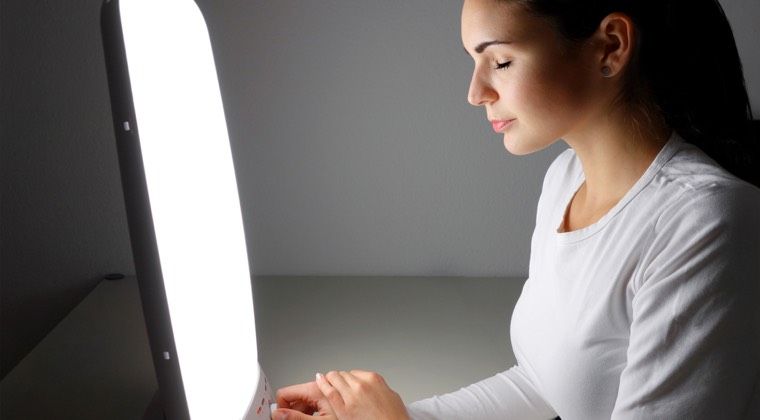
What is light therapy?
Light therapy consists of receiving moderate to high intensity Ultraviolet (UV)-free light, most typically from a light box or wearable light device. Light therapy is most effective when administered in the morning, close to your normal wake up time, for 30 minutes to 1 hour.
There is strong evidence to support morning light therapy as an effective antidepressant or mood enhancer in people prone to depression. Morning light therapy works best when it becomes a regular part of the morning routine, and occurs around the same time each day. Small studies have found morning bright light therapy can improve mood, sleep and pain in people with chronic pain (e.g., fibromyalgia, chronic low back pain).
How does light therapy work?
Morning light therapy may improve mood in several ways. Photoreceptors in the eyes transmit the light signal to the circadian clock (body clock) causing it to shift earlier, which often leads to improvements in mood. The same photoreceptors are attached to centers in the brain that regulate sleep, mood and pain, and may alter the levels of some neurotransmitters (e.g. serotonin) in these brain areas.
Thus morning light therapy may act directly on pain centers in the brain, but may also indirectly reduce pain by improving mood and sleep quality. Importantly, morning light therapy can be used in conjunction with other therapies to enhance pain reduction.
What other names might this go by?
Light therapy is sometimes referred to as light treatment. The photoreceptors in the eye are most sensitive to blue/green wavelengths of light. Bright white light boxes and wearable devices with blue/green wavelengths of light are equally effective. Dawn simulators are also available but are not as effective as bright light devices used with eyes open.
Where can I get a light device?
Light devices are available in some drug stores and also online. You do not need to get a prescription to purchase a light device. Some insurance plans may cover the cost.
What to expect
It can take a few days to get used to light devices and light therapy. After a few days, the morning light therapy will become part of your regular routine and it will be easier to get up each morning. You can still do many activities such as watching TV, reading or working on a computer during light therapy.
You should experience an improvement in mood after the first treatment and possibly further improvement after the first week of use. The benefits of morning light therapy can be enhanced by reducing competing evening light exposure.
Potential Risks
Light therapy is safer than going outside on a sunny day, as light therapy is less intense than a sunny day and light devices do not emit the UV-light present in sunlight. The most common side effects associated with light therapy are headache, eye irritation, and nausea, but these side effects are often temporary.
Light therapy could worsen some eye conditions such as macular degeneration and glaucoma. If you have an eye condition talk to your ophthalmologist before starting light therapy. Additionally, bright light can induce mania in people with bipolar disorder, so talk to your psychiatrist before starting light therapy.