
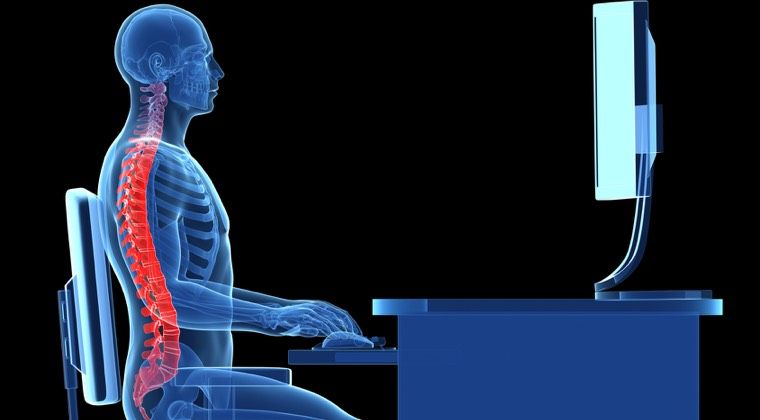
What are ergonomics?
- Ergonomics describes the process of finding the most efficient way to work in our environment.
- For example, if your desk is too low, you have a choice: (1) raise the desk (i.e., change the environment) or (2) change your posture to fit the lower desk (changing you).
- Ergonomics is about changing the environment to work for you.
- Using ergonomics reduces physical stress and fatigue.
- Ergonomics makes it easier for you to get things done.
Posture principles
- Your body is filled with muscles and joints that work together to help you move.
- These muscles and joints can be in positions that cause physical stress on the body, or they can be in positions that help to reduce stress and tension on the body as a whole.
- Posture is the word we use to refer to the best positioning of your body in any given moment.
- As time passes, your posture will also change.
- For example, one moment you might be standing at a counter cutting an apple.
- The next moment you might reach for a bowl.
- Your ideal posture has to change in order to accomplish the reaching task.
Posture and cell phones
- When possible, try to keep cell phones and tablets at eye level.
- Looking down at a device can lead to postural problems, muscle tightness, and headaches.
Please watch the video below about posture.
Run time: 6:01 minutes
Posture principles to follow
- Keep your head in line with your shoulders.
- Keep your shoulders in line with your hips.
- Rest your feet lightly on the floor.
- Center your weight between your butt and thighs.
- Your knees should be slightly below your hips.
- Your arms should hang comfortably down at your side.
- Elbows should be bent about 90 degrees for computer/table work.
- Eyes should be gazing straight ahead, with your head balanced naturally over your spine.
Ergonomic principles
Skip accordion section (9 items)- Seats should be adjusted to allow your feet to lightly touch floor.
- A footrest can be used if needed.
- The seatback should support the head-shoulder-hip alignment (more or less support may be needed in the lumbar area).
- The seat back should be locked or firm.
- Desks and table heights should allow for relaxed hand placement, without requiring elevation of shoulders or a sensation of reaching downward.
- The work area should be close enough to reach comfortably.
- Wheeled chairs will allow you to pull up closer to your workspace.
- Change positions often when you are sitting.
- Consider the use of a standing desk.
- Standing desks decrease discomfort by changing your posture.
- It allows you to continue your office work while being in a better position.
Principles to Follow
- Keep your head in line with shoulders.
- Keep your shoulders in line with your hips.
- Rest your feet lightly on floor.
- Center your weight between your butt and thighs.
- Keep your knees slightly below hips.
- Arms should hang comfortably down at your side.
- Bend your elbows about 90 degrees for computer/table work.
- Gaze straight ahead, with head balanced naturally over your spine.
Ergonomic Principles
- Adjust the seat to allow feet to lightly touch floor, or use a foot rest.
- Be sure the seat back supports head-shoulder-hip alignment (may require more or less support in the lumbar area).
- Stabilize the seat back. It should be locked or firm.
- Adjust the desk/table height to allow for relaxed hand placement, without requiring elevation of shoulders or a sensation of reaching downward.
- Check that the work area is close enough to reach comfortably. Wheeled chairs will allow you to pull up closer to your working surface.
- When sitting, be sure to change positions often.
- Consider the use of a standing desk, again by changing your posture, and allowing you to continue your office work.
A note about too much sitting
- Exercise is important to health and managing your pain.
- We must also make sure to limit how much inactive time we spend.
- Many adults are too “sedentary”, which means that we tend to sit more than is healthy.
- It is recommended that adults take a posture break at least every 45 minutes.
- A break can be stretching, putting in a load of laundry, adjusting your desk to use its standing feature, or even just a posture reset.
- Our bodies rely on these movements for health and well-being, and movement is an important part of a healthy lifestyle.
- Adults should get at least 150 minutes of exercise each week.
- We should move at least every 45 minutes- this doesn't have to be exercise but can be just standing up and walking around for a few minutes.
Please watch each video below.
Lifting (Run time: 0:06 minutes)
Bending (Run time: 06 minutes)
How to bend:
- Maintain the normal curves of your body.
- STOP and plan what activity you have to do, and how you will do it before you start.
- Get others to assist as needed. You don’t need to go it alone, together is better.
- Keep your posture active by doing a “reset” often, even every time you change position.
- When lifting or standing, know stability is key, and a wider stance can help with this.
- Use your hips and feet to turn, rather than twisting your back or knees.
- Keep things close to you when lifting/carrying.
- Keep good posture, and lift with your legs to move items, not with your back muscles.
Please watch the video below on posture
Run time: 13 seconds
This Posture Self-Check exercise is a way to make sure your posture is good. It can be done in a seated or standing position. Perform this exercise every time you sit down or are feeling like your posture is not as erect as you would like it to be. You should not be holding any position other than the “good” posture at the end of the exercise.
Instructions:
- Slouch so you are not falling over but are still bent forward.
- Next, overcorrect the slouch, so you are now backward bending your spine and looking up.
- Slowly return to a balanced position. You should feel neither slouched nor backward bent.
- Eyes should be looking straight ahead; you may feel like your spine is “reaching” toward the ceiling.
MYTH: People with pain have terrible posture.
FACT: All kinds of people have terrible posture.
- When you have pain in addition to poor posture, this can make the pain worse.
- The “perfect” posture does not exist.
- You will need to experiment to find the “best” posture for you, in any given moment or any given task.
MYTH: People with pain can’t do normal things because they are not strong enough to lift correctly.
FACT: The more you correct your posture and how you move, the better your posture and movement get. This translates into being able to do more with potentially less effort – even with pain.
What if it hurts too much to “fix” my posture right now?
- You may be hesitant to do much with your posture at first.
- The good news is that making posture changes can be done with slow, small steps.
- Every improvement you make is one more step toward a preferred posture habit.
- The effort you put in only adds to your success.
- Improvement in one activity will carry over to other physical activities in your life Posture correction is something performed in the moment, and changes over time.
- It will likely take at least a month before you see any noticeable, regular changes.
- These changes may be comments from others about you “looking taller.”
- You may feel that you can perform an activity for a longer period of time than previously.
- You may also notice that a particular task takes less effort than it used to.
- These are all signs of success, keep it up!
If improving your posture and ergonomics has been challenging for you in the past, you can still make strides by not going it alone. It may help you to:
- Talk with your healthcare provider about available resources in your area.
- Think about ways you can make small changes each day.
- Pick an activity to target for better posture, starting with an easier one, before you tackle something larger.
- Find a friend or family member to join you.
Maintaining good posture can be challenging for most people. Becoming more aware of your challenges may help you move past them.
If you are afraid that changing your posture will cause a flare-up, then:
- Consider whether you tried to change too much too soon in the past.
- Plan ahead and pace yourself.
- Think about the steps of the activity before you start.
- Give yourself permission to take breaks.
- Try thinking about having better posture/ergonomics as a way to help you feel better.
If you are not sure about what to do or how to start, then:
- Think about your past and present activities, and how you perform them.
- Pick one thing to do and start slowly.
- Keep track of what you do, strategies you have used, and how you feel doing it.
- Look at ideas available through organizations related to your specific condition.
- Organization websites have great information. (i.e., Arthritis Health Education | Arthritis A-Z)
- Talk to your healthcare provider about options, including occupational or physical therapy, and ergonomic assessment.
- Don't forget that everyone with pain has different abilities.
- Every day may be different. Just do what you can each day and build from there.
- If you struggle with balance and are prone to falling, you need to be especially careful about your personal safety.
- Avoid slippery floors, poor lighting, throw rugs, and other tripping hazards.
- Turn on a light if one is available.
- Use nightlights or motion sensor lights.
- Sit on the edge of the bed before getting up if you feel dizzy or tired.
- Choose postures that present less risk of falling, such as keeping two feet on the ground at all times and having something stable to hold on to.
- Use a handrail or grab bar if there is one available.
- Your balance may improve with improvements of your posture.
Many people who live with pain have challenges when they first start to make changes to their posture or environment. They may not know what to do, what activities they can do, or how to start. Here’s how to help them:
- Help identify activities that are particularly difficult.
- Think about which activities are likely connected with poor posture.
- Encourage them to track their progress, for example using PainGuide’s symptom monitoring features or downloadable worksheets
- Let them know that you would like to help them with some support and reminders about their posture and ergonomics.
- Help them create good balance when they are standing, walking, and moving by keeping themselves “centered” over their feet.
- Good posture is its own reward. Encourage your family and friends to use better posture and ergonomics in their own lives.